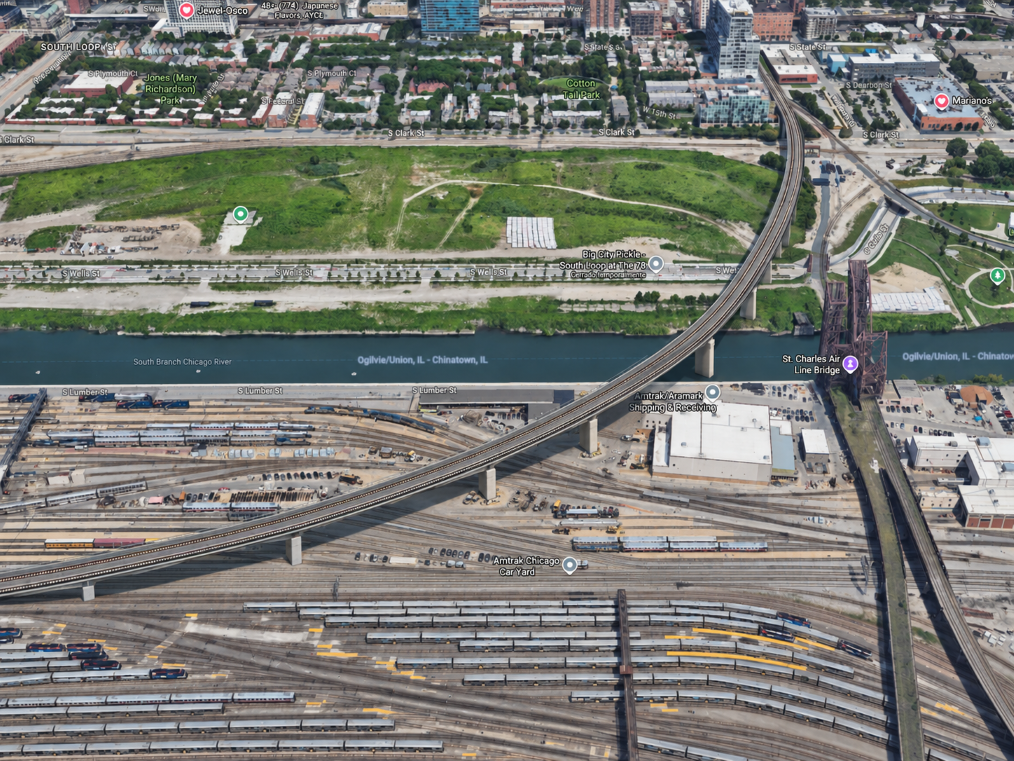
Chicago is currently developing two huge pieces of property immediately south of downtown, and I am concerned we are going to accidentally eliminate one of the most valuable future rail connections in the city while doing it. The Chicago Fire are building their new stadium at The 78 on the east side of the Chicago River, while the roughly 47-acre Amtrak 14th Street Coach Yard on the west side is being considered for a major redevelopment that could include a future White Sox stadium. I don’t have a problem with developing either property, but before we put permanent stadiums, buildings, roads, and utilities everywhere, I think we need to figure out what land Chicago’s rail system might eventually need.
The particular thing I am worried about is preserving the ability to create a direct connection from the St. Charles Air Line into Chicago Union Station. The St. Charles Air Line already runs east-west immediately south of downtown, crosses the Chicago River, connects with the Metra Electric corridor to the east, and crosses the Rock Island District as well. There is currently no direct northbound approach from the Air Line bridge into Union Station, even though Amtrak has studied building one and found the connection geometrically possible.
I am not saying we need to build this tomorrow, or that we even know exactly what the final project should look like. My concern is much simpler, which is that if there is a reasonable chance Chicago needs this connection 20, 30, or 50 years from now, we should preserve the land required to build it today. Once we build stadiums and high-rises over the possible alignment, we are either going to spend an absurd amount of money working around them later or just never build the connection at all.
Why the St. Charles Air Line is so useful
The St. Charles Air Line is interesting because it sits at basically the perfect location for connecting several railroad systems that currently operate mostly independently of each other. To the east you have Metra Electric, which runs down the lakefront and through the South Side. To the west and north you have Union Station and most of Chicago’s other commuter and intercity rail network, while the Rock Island District crosses the Air Line nearby and provides another major passenger corridor south toward Joliet.
Chicago has tons of railroad infrastructure, but because most of it was built by competing private railroads more than a century ago, the system is not particularly well connected. Metra Electric goes into Millennium Station, Rock Island goes into LaSalle Street, and BNSF, Milwaukee District, North Central Service, and several other lines go into Union Station. This isn’t necessarily bad on its own, since having multiple downtown stations can be useful, but it becomes a problem when trains have no way to move between these networks even when the tracks pass extremely close to each other.
That is why I think the St. Charles Air Line is so valuable. A relatively short new connection into Union Station potentially ties together rail infrastructure extending toward O’Hare, Wisconsin, the western suburbs, Joliet, the South Side, the south suburbs, northwest Indiana, Michigan, and eventually maybe an Illinois high-speed rail network. Not every one of these services would exist immediately and some require other infrastructure improvements, but preserving the connection gives future planners the ability to consider them.
Metra Electric trains could run to Union Station
The most straightforward service would probably be running some Metra Electric trains into Union Station instead of sending every train to Millennium Station. Millennium Station is a good terminal if you work near the eastern Loop, so I don’t think there is any reason to stop using it. The better system would give riders a choice, where some trains continue to Millennium while others travel over the St. Charles Air Line and into Union Station.
This would be particularly useful for anyone going to the West Loop or transferring to another train. Someone coming from Hyde Park, Pullman, Homewood, or University Park could take a Millennium Station train if they are going toward Michigan Avenue, while someone going to the West Loop could take a Union Station train. Anyone transferring to Amtrak, BNSF, Milwaukee District, or another service at Union Station would also have a much easier trip instead of having to get off at Millennium and travel across downtown.
There is nothing particularly unusual about a railroad having multiple downtown destinations depending on the train. New York does this with the Long Island Rail Road, where different services can reach different terminals depending on where riders are actually trying to go. I think Metra should eventually operate more like a regional transportation network rather than treating each historical railroad as an isolated system that happens to be operated by the same agency.
O’Hare to McCormick Place
One of the most interesting possible services is a direct train from O’Hare to McCormick Place, which was actually one of the ideas behind CrossRail Chicago. The North Central Service already has an O’Hare Transfer station, while Metra Electric already has a station built directly underneath McCormick Place. If the northern Metra network can through-run Union Station and continue over the St. Charles Air Line onto Metra Electric, those two places can theoretically exist on the same train route.
This would be an extremely useful service for conventions. Someone could fly into O’Hare, get onto a regional train, travel through Union Station, and get off underneath McCormick Place without having to take a taxi or take the Blue Line downtown and then figure out another way south. Chicago has one of the busiest airports and one of the largest convention centers in the country, so having the two connected by rail seems like something we should at least maintain the ability to do.
It also wouldn’t only be an airport express service, which is important because specialized airport trains can be difficult to justify economically. The same train could serve regular commuters along the North Central Service corridor, stop at Union Station for downtown passengers, and then continue south to McCormick Place and potentially farther down Metra Electric. By connecting infrastructure we already have, we can potentially create a useful airport service without building a completely separate railroad that is only useful to airport passengers.
Through-running trains through Union Station
The larger idea behind this is through-running, where Union Station becomes a station trains travel through rather than a place where virtually every train has to terminate. Chicago’s current commuter rail system is mostly designed around trains coming from the suburbs into downtown, unloading everyone, and eventually going back in the direction they came from. This made plenty of sense when the primary purpose of commuter rail was bringing downtown office workers into Chicago every morning, but the region has a lot more travel patterns than that now.
With a connection onto Metra Electric, you could eventually have a train come from somewhere north of downtown, stop at Union Station, continue past McCormick Place and Hyde Park, and then travel into the south suburbs. A different train could potentially enter from a western or northwestern line and continue onto another southern corridor. I am not particularly attached to one exact service pattern because the useful thing is creating the physical network that allows planners to design these routes later.
This also increases the usefulness of Union Station itself. Instead of every train needing platform space while it terminates and reverses, some trains can continue through the station and serve another part of the region. This is how many large regional rail systems work, and it makes the downtown station more of a central node within the network instead of simply being the end of a bunch of separate lines.
McCormick Place and Museum Campus
Another benefit is much better regional rail access to McCormick Place and the Museum Campus. Metra Electric already has the McCormick Place station, and the line also has an 18th Street station near Soldier Field, the Field Museum, Shedd Aquarium, and the rest of the Museum Campus. Those stations are currently mostly useful to someone who is already traveling on Metra Electric, which substantially limits the number of people who can conveniently use them.
If trains can travel from Union Station over the Air Line and onto Metra Electric, these locations become accessible from a much larger part of the rail network. You could run normal through services, special event trains, or potentially shuttle services between Union Station and 18th Street during major events. Someone coming into Chicago on BNSF, Milwaukee District, Amtrak, or another Union Station service could transfer directly to a train going to Museum Campus instead of leaving the station and taking another mode of transportation across downtown.
This becomes especially interesting for Soldier Field events because moving tens of thousands of people at once is exactly what trains are good at. Instead of adding more cars, buses, and rideshare traffic around the lakefront, Chicago could eventually have regional trains approaching 18th Street from multiple parts of the region. The station would obviously need to be rebuilt into something much larger, but the basic railroad is already there.
Rock Island and St. Louis trains
The St. Charles Air Line also crosses the Metra Rock Island District around 16th Street, which creates another potentially useful connection. Amtrak has already studied upgrading the connection between these tracks as part of its Chicago-area infrastructure planning, along with building a new Amtrak platform at Joliet. This could allow trains coming from downstate Illinois to use the Rock Island District between Joliet and Chicago rather than depending entirely on the existing freight-heavy route into the city.
The current Lincoln Service and Texas Eagle travel between Chicago and Joliet using railroad infrastructure that also handles substantial freight traffic. A future routing could instead bring trains north on the Rock Island District, connect onto the St. Charles Air Line, and then use the new northbound connection into Union Station. This would give Illinois another passenger-oriented approach into Chicago and could remove several places where passenger trains currently get caught up in freight operations.
There is also a Metra benefit here because Rock Island trains currently terminate at LaSalle Street Station. Just like with Metra Electric, I don’t think the goal should necessarily be moving every Rock Island train somewhere else. Having the physical connection could allow some trains to use Union Station or eventually through-run onto another corridor, while others continue serving LaSalle Street depending on where passengers are trying to go.
Amtrak trains from southern Illinois
The existing Amtrak services to Champaign, Carbondale, and New Orleans demonstrate another reason why a direct Union Station connection has been studied in the first place. These trains currently use the St. Charles Air Line but have to perform a time-consuming reverse maneuver because there isn’t a direct northbound track into Union Station. A direct connection would allow trains coming over the Air Line to simply continue north into the station.
There is an important caveat here because CREATE’s Grand Crossing project is also intended to solve this problem through a different route. If Grand Crossing is eventually built, the Illini, Saluki, and City of New Orleans could stop using the Air Line for their existing Chicago approach. I don’t think this weakens the case for preserving the Air Line connection though, because the larger value of the infrastructure comes from the additional future services it enables rather than only solving one awkward Amtrak movement that exists today.
Actually, I think this is a good example of why preserving railroad options matters. We do not know which projects will eventually get funded, what passenger services will exist in 30 years, or which corridors will become constrained. Having multiple ways to route passenger trains into one of the largest railroad hubs in the world seems more useful than intentionally reducing the number of available routes.
Michigan and eastern trains
There is potentially also a use for trains coming into Chicago from Michigan and the eastern United States, although this would require much more infrastructure than simply building the Union Station connection. Trains like the Wolverine, Blue Water, Pere Marquette, and long-distance eastern services currently have to travel through a very congested railroad environment in northwest Indiana and the southeast side of Chicago. Passenger rail planners have been studying South-of-the-Lake improvements for years because getting trains through this area reliably is one of the major problems facing Midwest passenger rail.
A future passenger-focused route through northwest Indiana could potentially approach Chicago using lakefront infrastructure and connect west toward the St. Charles Air Line. From there, the same northbound connection could provide access to Union Station without requiring trains to follow their current route through every existing freight bottleneck. This is much more speculative than the Metra Electric or Rock Island ideas because substantial infrastructure would need to be built east of Chicago, but that is exactly why I think it belongs in a discussion about preserving long-term options.
Maybe we never operate trains this way because another South-of-the-Lake alignment turns out to be better. Maybe we build a dedicated passenger railroad from Indiana that makes this connection extremely useful. We don’t know, and spending a relatively small amount of effort preserving the Chicago end of a possible route seems like a better decision than finding out decades from now that the rest of the project works but the final mile into Union Station has a stadium sitting on top of it.
High-speed rail makes this more important
Illinois is also studying future high-speed and higher-speed rail routes between Chicago and St. Louis, including Chicago approaches that make use of the Metra Electric corridor. That should immediately make the land around the St. Charles Air Line more important because Metra Electric does not naturally enter Union Station. If Illinois eventually spends billions of dollars creating faster passenger service using that corridor, we should probably maintain the option of connecting it to Chicago’s primary intercity rail station.
There might be a perfectly good reason for some future train to terminate somewhere else, and Millennium Station itself could theoretically become an intercity terminal with enough investment. But Union Station already has Chicago’s largest collection of Amtrak and Metra connections, so it seems shortsighted to eliminate the possibility of reaching it before the state has even decided what its future high-speed rail network will look like. At a minimum, the high-speed rail study and the planning of The 78 and Amtrak yard redevelopment should be talking to each other.
This is another situation where timing matters a lot. Illinois is currently deciding what its future passenger rail system could look like at the exact same time that some of the most strategically located railroad-adjacent property in Chicago is being redeveloped. If we know these decisions interact with each other, we should coordinate them now rather than discovering the conflict after everything has already been built.
The Amtrak 14th Street yard
My second concern is the redevelopment of Amtrak’s roughly 47-acre 14th Street Coach Yard immediately south of Union Station. Amtrak is planning a new maintenance facility farther south, and there seem to be legitimate reasons for replacing the existing facility with something more modern and better designed for current equipment. I don’t have a problem with moving the maintenance operation if the new facility actually works better.
What concerns me is assuming that because the maintenance facility can move, all 47 acres of the existing railroad property have no future transportation value. This is an enormous amount of contiguous railroad land immediately next to Union Station, and once it becomes a stadium and mixed-use development we are never going to recreate something like it. Even if Amtrak only needs a small portion of the property for some future purpose, figuring that out after everything is constructed is going to be a lot more difficult.
Passenger rail service in Chicago should hopefully be significantly larger 30 or 50 years from now than it is today. If Amtrak service doubles, Midwest high-speed rail gets built, or Metra begins operating much more frequent regional service, we may need additional train storage, approach tracks, platforms, maintenance access, electrification equipment, or things nobody is seriously planning for right now. Yard space and railroad right-of-way are annoying infrastructure problems because nobody cares about them until a project needs the land, at which point finding a replacement can become one of the hardest parts of actually building anything.
I don’t know how much of the existing yard needs to remain railroad property. Maybe engineering shows that almost all of it can safely be developed, which would be great because that’s an enormous amount of valuable land that can be put to another use. I just want somebody to answer the transportation question before a real estate transaction and stadium plan answer it for us permanently.
The 78
The same general issue applies to The 78, although the situation is somewhat different because the Chicago Fire stadium is already under construction there. The 78 is an enormous development, and there is obviously going to be much more built around the stadium over the coming decades. If any reasonable future St. Charles Air Line approach requires property, air rights, clearance, or another easement through the site, we need to identify that requirement before the rest of the neighborhood fills in.
This does not mean the City of Chicago needs to buy The 78 or prevent it from being developed. Maybe the required property is just a narrow strip, or maybe a future elevated structure can cross a portion of the development as long as buildings are kept out of a particular envelope. Engineers can figure out the exact requirement, while the important policy decision is simply making sure that whatever small amount of space is necessary remains available.
Related and the Fire could then build around the preserved corridor, which is much easier than designing an entire railroad around completed buildings later. Chicago has enough experience with elevated rail infrastructure that incorporating future transit rights-of-way into a development should not be some impossible concept. If anything, having access to a future regional rail connection could ultimately make the surrounding property more valuable.
The economics are mostly about keeping options open
I think the economic argument for preserving this land is actually pretty simple because we don’t have to prove that every service I described above will eventually exist. The relevant comparison is the cost of preserving a relatively small amount of right-of-way today against the cost of trying to recreate the same right-of-way once the land is completely developed. Acquiring a strip of undeveloped or railroad property and designing buildings around it is obviously going to be easier than buying completed buildings, relocating utilities, working around stadium foundations, or deciding we now need a tunnel because the surface and elevated alignments disappeared.
Railroad land is also different from most normal real estate because location is basically everything. If an office developer loses one parcel, they can usually build the office somewhere else. If a railroad needs a particular curve between two existing tracks in order to meet acceptable grades and turning radii, a random five-acre property a mile away does absolutely nothing for them.
This gives preserving the corridor a kind of option value, which I think is the right way to think about it. We don’t have to know whether the eventual use is Metra Electric service to Union Station, O’Hare to McCormick Place, high-speed rail, Rock Island trains, Amtrak, through-running, or some service we haven’t thought of yet. We are spending some amount of money and development flexibility today so that future Chicago still gets to make that decision instead of us making it for them by constructing something permanent in the way.
There is of course some limit to this logic because we cannot reserve every potentially useful piece of land in Chicago forever. But this isn’t some random corridor somebody drew across an empty neighborhood, since the St. Charles Air Line already exists and Amtrak has already studied the direct Union Station connection. When there is an existing railroad connecting several major passenger corridors and the missing link is a relatively short connection into the region’s primary rail station, I think preserving that possibility meets a pretty high bar for being worthwhile.
What should happen now
What I would like to see is a coordinated engineering study between the City of Chicago, IDOT, Metra, Amtrak, and the agencies working on Illinois high-speed rail. They should determine what a reasonable direct northbound connection from the St. Charles Air Line into Union Station would look like, what improvements should be preserved around the Rock Island crossing, and what land or air rights those projects would require. The goal shouldn’t be selecting one massive project and committing billions of dollars today, but simply figuring out which physical options need to remain possible.
The same study should look at the Amtrak yard and determine whether any part of that property has strategic value for the long-term expansion of Union Station and Chicago passenger rail. If the answer is that 95 percent of the property can be developed and only a narrow corridor needs protection, that is a useful result because developers now know exactly what they can build around. If the answer is that significantly more land is needed for future tracks or train storage, then we should probably know that before the property becomes permanently unavailable.
I also think Illinois’ high-speed rail planning should explicitly consider this because the state is currently studying routes that may use Metra Electric. It doesn’t make much sense for one planning process to spend years determining whether Metra Electric is a good approach for future trains while another process eliminates one of the most obvious ways those trains could reach Union Station. Someone needs to look at all of these projects on the same map and make sure we aren’t solving one problem while accidentally creating another.
Altogether
I like development, and I think both The 78 and the Amtrak yard should eventually become much more active parts of the city than they are today. I also like the idea of having new sports stadiums near transit and downtown rather than surrounded by enormous parking lots, so my concern isn’t really about whether these neighborhoods should be built. My concern is that good development today shouldn’t require eliminating good infrastructure projects tomorrow when we have the ability to plan for both.
The St. Charles Air Line is a weird piece of Chicago railroad infrastructure that happens to sit at an extremely useful location between Union Station, Metra Electric, Rock Island, McCormick Place, Museum Campus, and several possible future intercity rail corridors. Building a direct connection into Union Station could eventually enable Metra Electric trains to the West Loop, direct O’Hare to McCormick Place service, regional through-running, new Rock Island and downstate Amtrak routings, better Museum Campus access, and potentially connections into future high-speed rail. Some of these ideas will probably turn out to be better than others, and I’m sure transportation planners 30 years from now will come up with uses for the connection that I haven’t thought about.
This is why I think the important thing right now is not deciding exactly what trains should run over it. We need to identify the right-of-way, preserve whatever property and air rights are necessary, and then continue building the rest of the neighborhood around it. If we eventually decide the connection isn’t useful, we lost a relatively small development constraint, but if we build over it and discover later that we needed it, getting the opportunity back could be effectively impossible.