AI models are complicated and highly price elastic products that when deployed and used intensively by hundreds to thousands of employees, can mean one enterprise pays $1 million for $100 million in productivity gains, while another pays $10 million for $30 million in productivity gains.
Additionally, every time a new model comes out, every second spent using older, less efficient models means money down the drain. Given how fast new models release, it’s important for enterprises to consistently remain on top of what AI systems available and effectively implement it in their businesses.
Given these conditions, here are some common issues enterprises face and how to solve them.
Which models do we provide to users?
Provide an auto router. Collect human feedback like with cross comparison responses (users have to answer quickly).
Give employees a list of 3 power levels of models to select from, and they can expand for more based on what they need.
An expansion list would provide the best models on the edge of the best value curve. Power users would be able to use any of these, however, your company should probably optimize around 7-8 max.
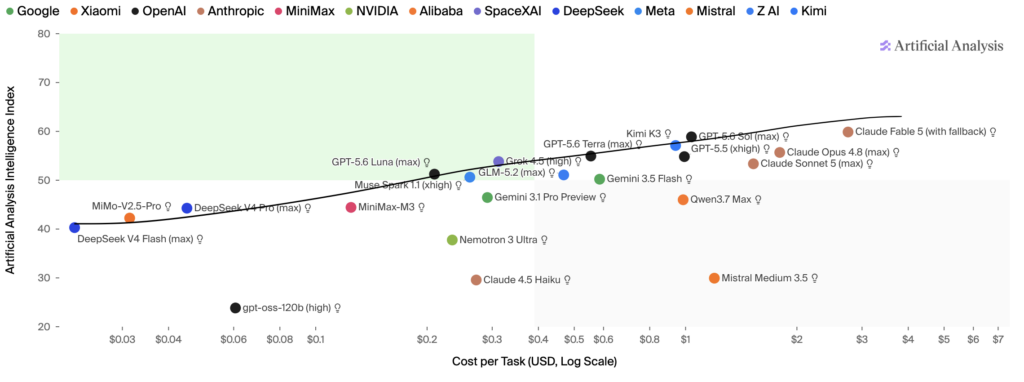
There’s a third axis on this chart, and that’s speed, and something to consider as well.
You need to balance the three factors that determine a model’s value (the AI Trilemma):
- Cost per task
- Speed per task
- Output quality
How do we decide AI usage budgets?
Assign usage budgets to project/task budgets, not to per-employee budgets.
This way project managers can see the actual ROI AI usage has returned for a project.
Of course, such platforms do not really exist at the moment / directly integrate with project management platforms, so enterprises should take the chance to build out this integration.
If a user needs more money beyond what they budgeted for, have them consult their manager or team about why.
Companies should adopt platforms that allow managers to review what their employees are using AI for. Managers can use AI to summarize what their employees are using AI for, without having to read through all the AI use themselves.
Should and how should we run benchmarks on the latest AI models and harnesses?
Maybe. AI evaluation companies and benchmarks that you can freely access or pay for do exist. However, your business’s use cases for AI might not be covered and you might like more transparency into how well AI is performing with your employees’ tasks. In that case, yes, establish benchmarking systems.
And benchmark model + harness, not just the model.
What software do we build or buy right now?
With the cost of vibe coding decreasing at least 10x per year, build what software can pay itself off in the within the next 3 months. Prioritize the quick wins, not the large reaches. Other people are building the large reaches for you which you can later buy. Eventually, all organizations will fully collapse to one data plane, however, it will take progressive consolidation to get there.
As always, buy what software immediately delivers value right now vs the time it would take to develop, even with accelerated coding (vibe coding has costs). Vendor lock-in is a worry, however, with models becoming highly capable of extracting and replicating data, moving your data out of closed systems is becoming easier and faster every day.
How do we secure agentic systems?
Agents that have access to the internet that can download and run software (Claude Code, Codex, etc) are huge security risks to organizations.
- Utilize a internal package repository that is security vetted
- Control all software development through an integrated development platform
- Do not allow employees to download and execute 3rd party software without review.
- Test and trust models’ prompt injection protections.
Limit model switching and context windows to maximize caching and minimize spend
This is a difficult topic. Due to caching, continuing to use a more expensive model despite the remaining tasks in a chat being less difficult may actually be cheaper than switching to a less-powerful model.
Companies should adopt platforms that smartly manage conversations and recommend to users to not switch models or to start new tasks. This can be a custom trained model that makes this decision, similar to an auto router.